
The sponge next to your sink looks harmless. Science says otherwise.
What researchers found inside used sponges
In 2017, microbiologists at Furtwangen University in Germany studied 14 used kitchen sponges. They found 362 different types of bacteria. In some spots, the density reached 45 billion bacteria per square centimetre, comparable to a toilet. Most were harmless, but some were related to bacteria that can cause infections. (Study: Scientific Reports, 2017)
The researchers also found that sponges their owners “cleaned” regularly, in the microwave or with hot water, were not germ-free.
Why sponges and green scrub pads trap germs
Bacteria need three things: water, food and warmth. A dishwashing sponge gives them all three.
- Holds water: foam soaks up water and stays wet for hours, often until the next wash.
- Traps food: tiny pores and dense fibres hold bits of dal, rice and oil that you cannot rinse out.
- Warm and dark inside: the inside of a sponge or thick green pad never dries in a humid Indian kitchen.
Green scrub pads have the same dense, fibre-packed build, so food and water get trapped inside them too. They are also rough enough to scratch non-stick coatings.
Why a wire mesh cloth stays cleaner
A KRHE steel wire dish wash cloth is built differently, and it beats both the sponge and the green cloth on hygiene for two simple reasons: it dries quickly, and dirt and food particles do not stick to it. They rinse straight off the smooth metal-coated mesh under running water.
| Foam sponge / green pad | KRHE wire mesh cloth | |
|---|---|---|
| Structure | Thick, porous, packed fibres | Thin, open mesh |
| Water held after use | A lot | Very little |
| Drying time | Hours, often stays damp | Dries fast |
| Food stuck inside | Hard to rinse out | Particles don’t stick, rinse off under the tap |
| Safe on non-stick | Green pad can scratch | Non-scratch |
A cloth that dries fast and holds no trapped food gives bacteria nowhere to grow. That is why the wire mesh cloth is the cleaner choice over a sponge or green cloth.
Keep any scrubber cleaner
- Rinse it well after every use until no food is left.
- Squeeze out water and hang it to dry; never leave it in a wet sink.
- Keep separate scrubbers for utensils and for counters.
- Replace it regularly, as soon as it smells or looks worn.
Switch to a cleaner scrubber
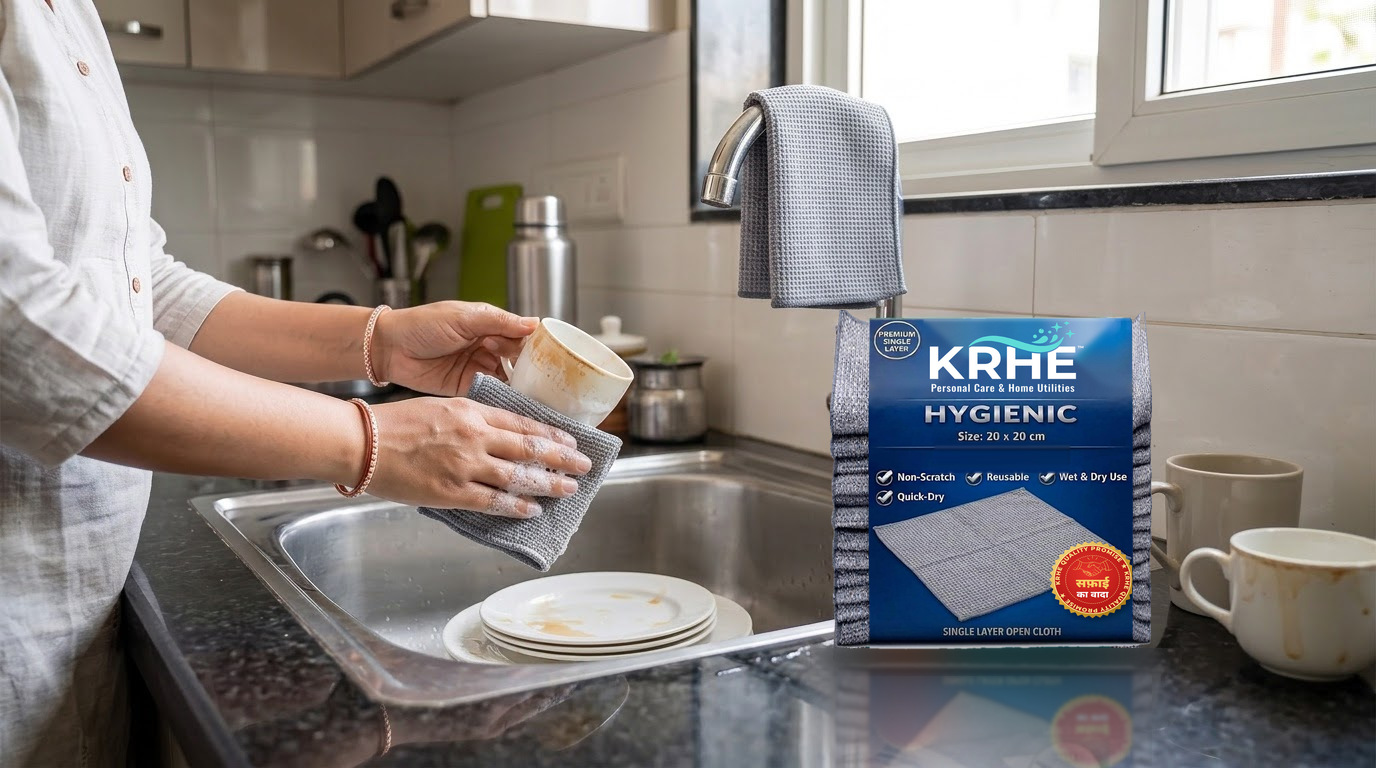
The KRHE Single Layer is for daily dishes and non-stick; the KRHE Double Layer is for burnt kadai and greasy stoves. Packs of 5, 15 and 25, free delivery across India. Safai ka Wada.
Leave a Reply